
The story is not that which unfolds but that which is told.
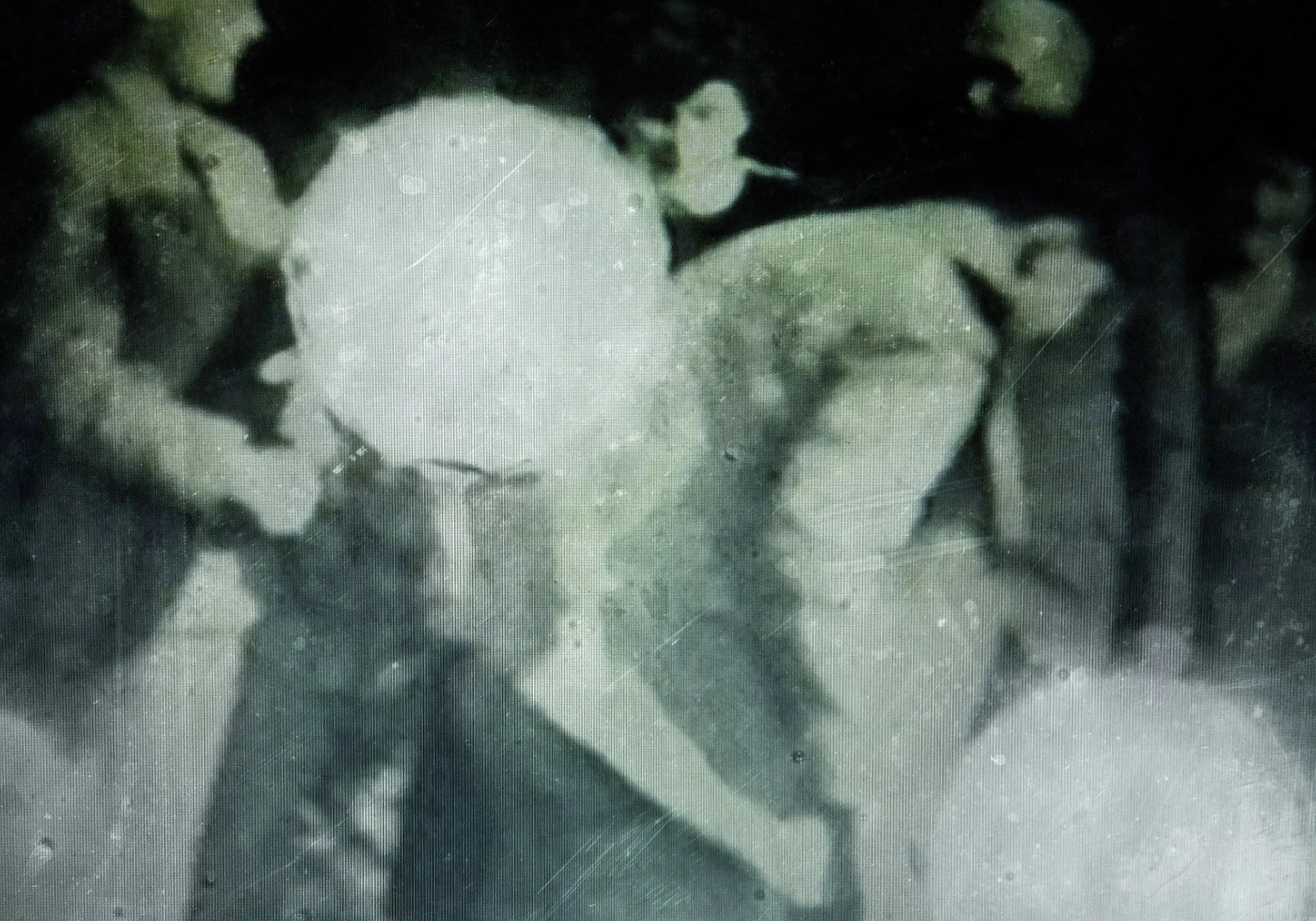
The year may as well be 1951, when my father was 20 years old. The occasion was a family gathering perhaps in the garden of their house to celebrate, something.
He is dead now so I cannot ask him.
All that remains is a poorly digitised version of a VHS version of an ancient cine-film. I remember it projected onto a white roll-down surface like a ship’s sail whose mast was a thin metal tripod in the middle of a darkened room. It moves smoothly with few stutters or abrupt pauses but from today’s perspective it is debris. The surface of the film is scratched and pock-marked and there are water-marks as if it had been washed. It was only ever meant as a souvenir, an approximation of the moment, but now that all those present are gone it has become the event itself, inexplicable and intriguing.
Most interesting are the large white circles that flash across the image in various places, often in pairs but with no recognisable pattern or cause. They are almost instantaneous but frame by frame have a visible duration. They leap across the film, changing places with each other, haloed in a trembling corona as if the image behind is melting. In the flickering of the damaged celluloid they appear alive, mingling with the family crowd whose gestures and expressions change as abruptly as the shadows that overtake them, caught in their moment.
My father dances with a comical, loping gait dressed in his casual suit and tie. He is not alone, there are others dancing, but he seems more intent on acting out the folly of the thing, performing for his family pursued by the balls of light. A woman, his mother, laughs at her son as, round and round they go in the warm afternoon, capering out of shot and back again, up and down, arms swinging, faces lit by foolish grins that are only just recognisable in the thin and murky film of the event. Grains of shadow tremble in the folds of the people’s clothes. Spots of water fall through the air and streaks of white light flash between them, all in silence. There must have been music but none remains now.
… Neither movement from nor towards,
Neither ascent nor decline. Except for the point, the still point,
There would be no dance, and there is only the dance.
I can only say, there we have been: but I cannot say where.
And I cannot say, how long, for that is to place it in time…
From: Burnt Norton, T.S. Eliot